What Is AI, Really?
Let’s start with the honest truth: most people who use the word “AI” every day would struggle to explain what it actually is. And that’s not a criticism — it’s just a sign that the technology moved faster than the education did.
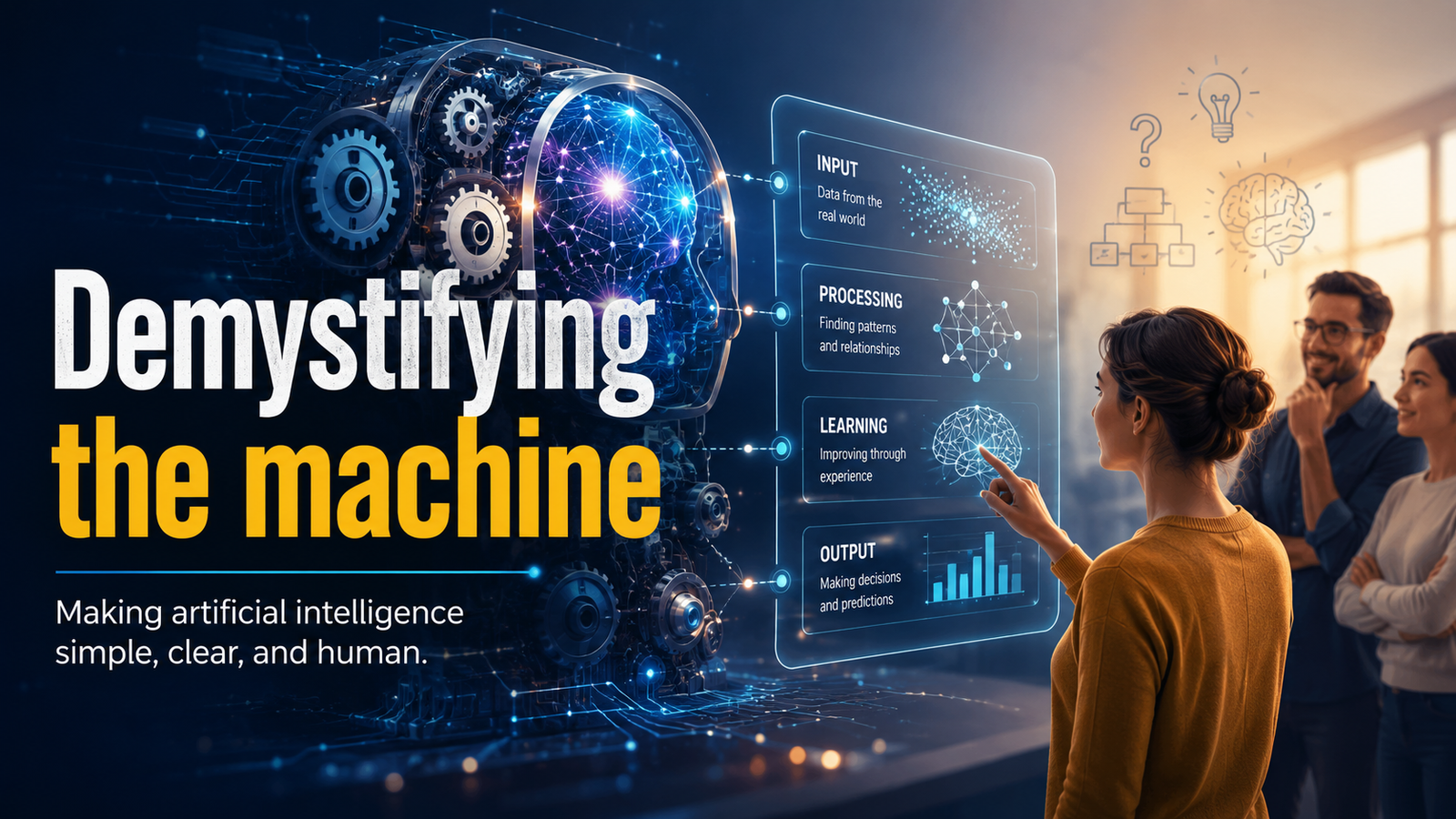
At its most basic, artificial intelligence is software that is trained to make decisions. Not programmed with rigid rules — trained on examples. That’s the key difference. Traditional software follows instructions you write: if the user clicks this button, do that thing. AI software learns patterns from large amounts of data and uses those patterns to make predictions or generate responses.
“AI doesn’t think like you. It doesn’t think at all. It recognizes patterns at a scale no human ever could—and that’s what makes it powerful.”
The versions of AI we interact with most today—ChatGPT, Gemini, and Claude—fall under a category called “Generative AI.” These systems don’t just classify or predict; they create. They generate text, code, images, and audio that didn’t exist before the prompt was given.
The Simple Version
AI = software trained on examples, not programmed with rules. Generative AI = AI that creates new content based on what it has learned. Large Language Models (LLMs) = the specific type of generative AI that reads and writes text.
How Large Language Models Work — Simplified
When you type a message into ChatGPT or Gemini, something fascinating happens in the background. The system doesn’t retrieve a pre-written answer from a database. It generates a response, one word at a time, based on what it has learned is most likely to come next.
Here’s the intuitive version: imagine you’re playing a sophisticated version of autocomplete. Your phone’s keyboard suggests the next word as you type. An LLM does that, but trained on hundreds of billions of words from the internet, books, research papers, and code—and it does it with deep contextual understanding across thousands of words simultaneously.
“An LLM is not a search engine. It doesn’t look things up. It predicts what a knowledgeable person would say — and sometimes it gets that wrong.”
That’s why LLMs can write code, explain history, draft emails, and translate languages — they’ve seen enough examples of all of those to have learned the patterns. But they’ve also inherited the biases, errors, and gaps in whatever they were trained on.
Key Terms Decoded
The AI world runs on jargon that can make beginners feel like outsiders. Here are the four terms that come up most often—explained plainly, with a real-world analogy attached to each.
AI Vocabulary, Decoded
| Term | What It Means | Analogy |
|---|---|---|
| Token | The basic unit an AI model reads and writes. Roughly a word or word fragment. | Like letters to a typewriter — the raw material of language. |
| Parameters | The numerical settings inside a model, adjusted during training. A model with 70B parameters has 70 billion tunable knobs. | Like the tuning dials on a massive, invisible instrument. |
| Training | The process of exposing a model to enormous amounts of data and adjusting its parameters until it improves. Can take months and cost millions. | Like years of school and practice — compressed into compute. |
| Inference | The moment a trained model is used — when it takes a prompt and generates a response. Every ChatGPT message triggers an inference. | Training is studying for the exam. Inference is sitting the exam. |
A Map of the AI Landscape
“AI” is not one thing. It’s a family of technologies, tools, and approaches. Here’s the lay of the land as it stands today.
The AI Landscape at a Glance
| Category | Description | Examples |
|---|---|---|
| Large Language Models | The core technology powering most AI tools. Trained on text, they read and write language with remarkable fluency. | GPT-4o, Gemini 2.0, Claude 3.5, Llama 3 |
| Chat Interfaces | Friendly, conversational access to LLMs. Ask anything, get instant answers. | ChatGPT, Claude.ai, Gemini |
| AI Dev Platforms | For building products and workflows on top of AI models. | AI Studio, OpenAI API, Vertex AI |
| No-Code AI Builders | Build AI-powered apps and flows without writing code. | Stitch, n8n, Make |
| Image & Audio AI | Generative AI beyond text — creating images, music, and video. | Midjourney, DALL·E, Suno |
| Autonomous Agents | AI systems that can take actions and complete multi-step tasks. | Claude Code, Devin, AutoGPT |
Common Misconceptions Debunked
AI is one of the most misunderstood technologies of our time. Here are six misconceptions that cause the most confusion.
| Misconception | The Reality |
|---|---|
| “AI is conscious and thinks like a human.” | AI has no consciousness, feelings, or self-awareness. It produces outputs that sound human because it was trained on human text — not because it experiences anything. |
| “AI knows everything and is always right.” | LLMs hallucinate — they confidently generate incorrect information. Always verify important outputs, especially facts, numbers, and citations. |
| “AI will take all the jobs.” | AI will change the nature of many jobs and eliminate some tasks. But it also creates entirely new categories of work — including roles that didn’t exist five years ago. |
| “You need to be technical to use AI.” | The most powerful AI tools are available through a chat interface. If you can write a clear message, you can use AI effectively. |
| “AI is only for Silicon Valley.” | Today’s AI tools are accessible, affordable, and increasingly built for global users. Builders in Lagos, Nairobi, and Accra are shipping AI products right now. |
Where to Go Next as a Beginner
Understanding AI conceptually is only the first step. The real learning happens when you start using these tools with intention.
Your First 5 Moves
Create a free account on Gemini and ChatGPT. Both free tiers are powerful enough for learning and most daily tasks.
Give it a real problem, not a test question. Ask it to help you draft an email, explain a concept, or outline a project.
Notice when it gets things wrong. When something sounds off, verify it. This critical habit separates effective AI users from everyone else.
Learn to write better prompts. The quality of your output is directly proportional to the quality of your input.
Follow the Scholar Suite AI Literacy series. We’re building a structured path from zero to fluency.
“The people who will thrive in the AI era are not the ones who fear it or blindly trust it — they’re the ones who understand it well enough to use it with intention.”