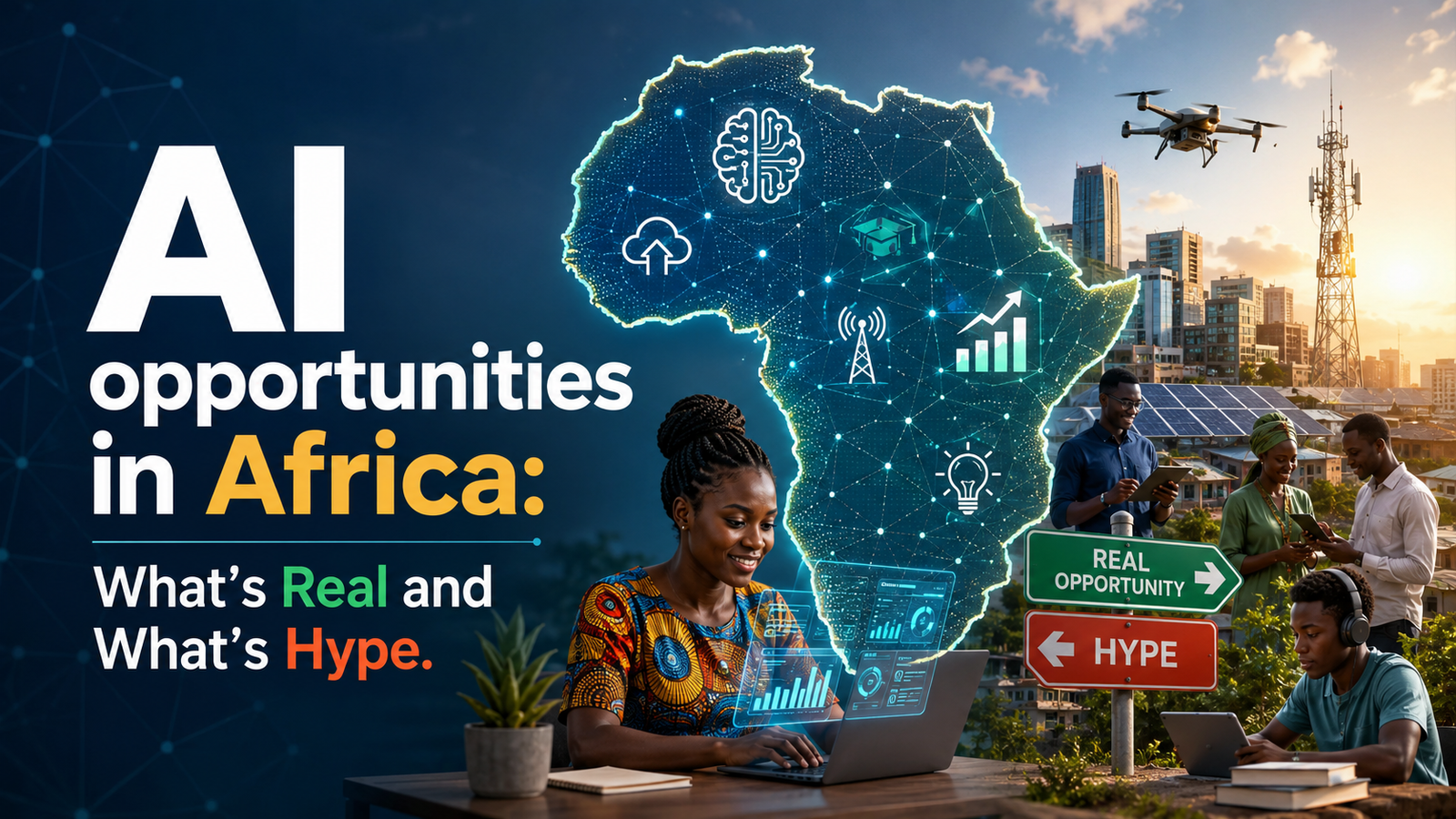
AI Opportunities in Africa: What’s Real and What’s Hype
The AI Opportunity in Africa: What’s Real, What’s Hype
Every major technology wave of the last thirty years has produced the same headline about Africa: enormous potential, not yet realised. So when AI arrives with similarly loud fanfare, skepticism is reasonable.
Here is what is different this time: the tools are accessible, affordable, and require no physical infrastructure to deploy. AI needs a browser tab and an internet connection. That changes the calculus significantly for a continent where software builders have consistently outrun the physical infrastructure they were supposed to depend on.
“African builders don’t need to adapt AI for local problems. They understand the local problems better than anyone who built the AI tools in the first place.”
The real opportunity is not that AI will solve Africa’s problems automatically. It is that African builders, armed with these tools and deep local knowledge, can build solutions at a fraction of the cost and time it would have taken five years ago.
The Honest Picture
The hype: AI will automatically lift African economies. The reality: AI gives African builders a new set of powerful tools. What they build — and how well those products fit local needs — is entirely up to them. The opportunity is real. The work is still the work.
Working with AI Under Bandwidth and Infrastructure Constraints
Most AI tools were built and tested on fast, stable internet connections. The result is tools that are powerful but occasionally impractical where data is expensive, connectivity is intermittent, and electricity cannot be taken for granted. This is not a blocker — it is a design constraint.
African Infrastructure Constraints & AI Workarounds
| Constraint | Impact on AI Use | Practical Workaround |
|---|---|---|
| Expensive mobile data | Heavy AI interfaces, image generation, and video are costly to run on mobile data. | Use text-only interfaces. Write prompts offline, send in batches. |
| Intermittent connectivity | Long sessions time out; multi-step workflows break mid-task. | Break work into short, self-contained prompts. Copy outputs locally immediately. |
| Load shedding / power cuts | Sessions lost mid-conversation; device battery depleted. | Save AI outputs immediately to Google Docs. Work critical tasks during stable power windows. |
| Low-spec devices | Heavy browser-based AI tools lag or crash on older hardware. | Use mobile apps. ChatGPT and Gemini apps are optimized. Close unnecessary browser tabs. |
| Limited cloud storage | Cannot store large AI-generated datasets or media files long-term. | Use Cloudflare R2, Supabase storage, or Google Drive. |
Local Use Cases: Education, Fintech, Agriculture, Health
The most powerful AI applications are not the ones built for Silicon Valley. They are the ones built with precise knowledge of a specific context and specific market gaps. African builders have that knowledge in abundance.
High-Impact AI Opportunities by Sector
| Sector | The Problem | AI Application |
|---|---|---|
| Education 📚 | Overcrowded classrooms, undertrained teachers, and zero personalized learning at scale. | AI tutors in local languages. Personalized practice generators. WAEC and JAMB prep tools. |
| Fintech 💳 | Millions unbanked. Credit scoring excludes those without formal financial histories. | Alternative credit scoring via mobile data. AI-powered fraud detection. WhatsApp banking agents. |
| Agriculture 🌾 | Smallholder farmers lack extension services, market pricing, and crop disease warnings. | Crop disease diagnosis from phone photos. AI advisory via SMS in local languages. |
| Health 🏥 | Doctor-to-patient ratios far below WHO standards. Paper-based records. | Symptom triage chatbots. AI-assisted diagnostics for community health workers. |
Building AI-Powered Products for Nigerian and West African Markets
Building for a Nigerian or West African user is not the same as localizing a product built for someone else. It means designing from the ground up with specific realities in mind.
Language is the first design decision. Nigeria alone has over 500 languages and three major regional lingua francas—Yoruba, Hausa, and Igbo—alongside Pidgin. An AI product that only works in formal English already excludes a significant portion of its intended audience.
“Design for the user in front of you, not the user you wish you had.”
WhatsApp is infrastructure. For most Nigerian users, WhatsApp is not a messaging app — it is the internet. Products that integrate with WhatsApp meet users where they already are. AI agents delivered via WhatsApp have dramatically higher adoption rates than standalone app equivalents.
The Builder’s Checklist for West African AI Products
Works on 3G or intermittent connectivity · Has a WhatsApp or SMS touchpoint · Supports at least one Nigerian language beyond English · Integrates Paystack or Flutterwave · Loads and runs on a mid-range Android device · Has been tested by actual users in the target market
Ethics, Data Privacy, and Policy Considerations
Building responsibly with AI in the African context involves specific ethical considerations that global frameworks often miss.
| Consideration | What This Means for Builders |
|---|---|
| Bias in training data | Most leading AI models were trained predominantly on Western, English-language data. Always test AI outputs for local relevance before deploying. |
| Data privacy (NDPA) | Nigeria’s Data Protection Act mirrors GDPR in key areas. Any product collecting Nigerian user data must comply. Don’t feed user data into third-party AI APIs without understanding their data practices. |
| Community impact | AI products that automate tasks in low-income communities may eliminate livelihoods. Build with awareness of who gains and who loses. |
| Sovereignty & dependency | Relying entirely on foreign AI APIs creates dependency on pricing decisions outside your control. Build with multi-provider architectures where possible. |
| Regulatory landscape | Nigeria’s NITDA and the Central Bank regulate aspects of AI in financial services. Build compliance awareness in from day one. |
| Misinformation risk | AI-generated content at scale in markets with lower institutional trust can accelerate misinformation. Products serving news, health, or financial info must have human review layers. |
Ecosystem Resources: Communities, Funding, and Platforms
No builder succeeds in isolation. Here are the most relevant communities, platforms, and funding pathways for builders working with AI in Africa.
| Resource | What It Offers |
|---|---|
| Ingressive for Good (I4G) | One of Africa’s largest tech communities, with programs across Nigeria covering technical skills, internships, and builder networks. Strong university presence. |
| Google Developer Groups (GDG) Nigeria | Active chapters in Lagos, Abuja, and Ibadan. Regular AI workshops and direct access to Google’s developer programs, including AI Studio credits. |
| Techstars Africa & Google for Startups | Africa-specific accelerators with non-dilutive funding, mentorship, and cloud credits. Google for Startups offers AI training and cloud credits for early-stage AI companies. |
| Google AI Studio (Free Tier) | Access to Gemini API with a generous free tier — no credit card required. Essential for African builders prototyping AI products without upfront costs. |
| Hugging Face | The world’s largest open-source AI model repository. Several African language models are available and actively maintained here. |
| Scholar Suite Blog | The AI Literacy series is designed specifically for Nigerian and African builders starting their AI journey. |