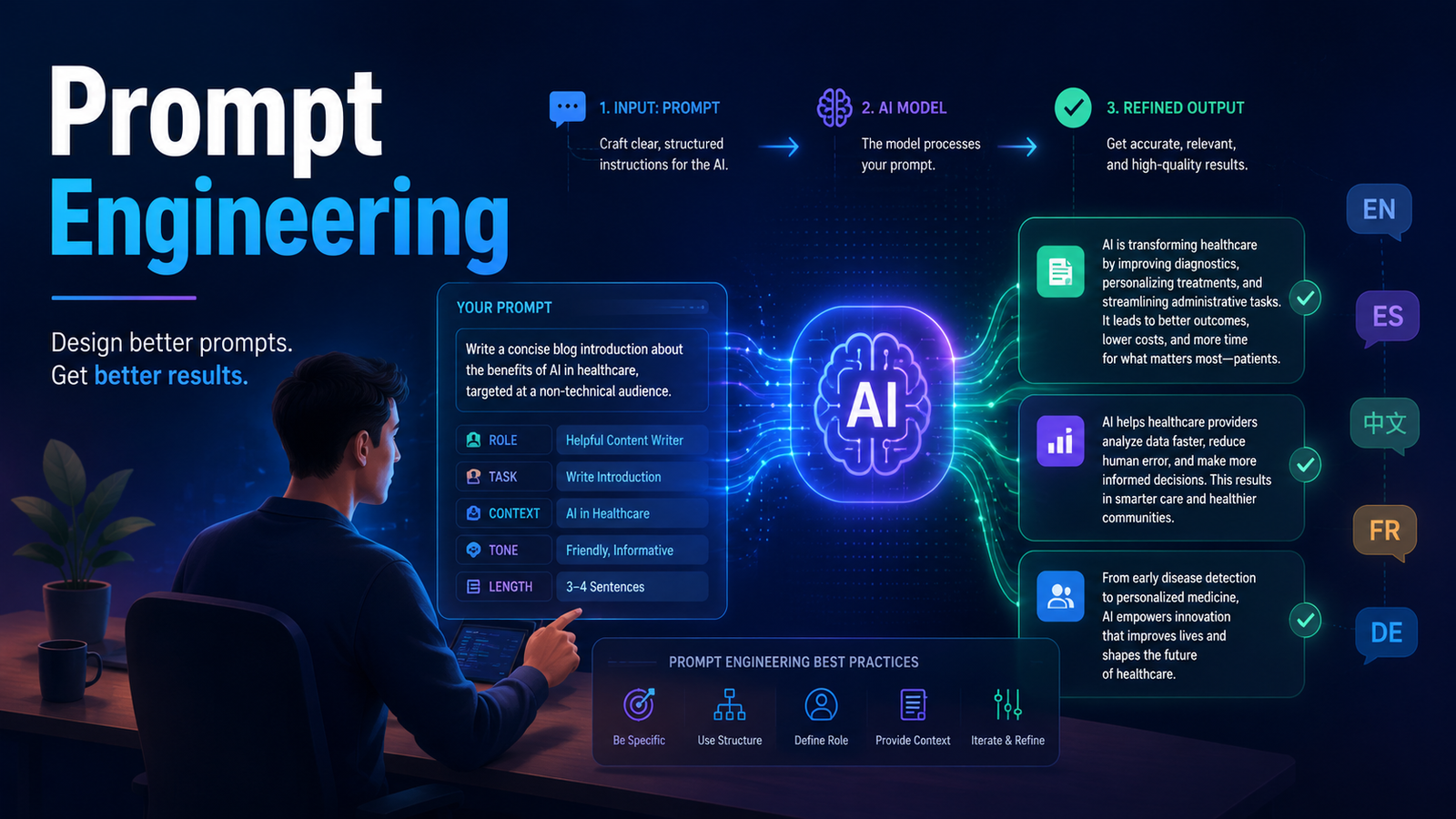
Prompt Engineering
What Prompt Engineering Is—and Why It Matters
There’s a version of AI interaction that most people are stuck in: type something vague, get something mediocre back, shrug, and decide that “AI isn’t that useful.” Then there’s another version—where the same tools produce remarkable, genuinely useful outputs on the first or second attempt.
Prompt engineering is the practice of designing inputs to AI systems in order to get the best possible outputs. It’s not a technical skill in the traditional sense—you don’t need to write code. But it is a communication skill, and like all communication skills, it rewards deliberate practice.
“AI doesn’t read your mind. It reads your words. Write better words.”
Why This Matters Right Now
As AI tools become more embedded in every kind of work—writing, coding, design, research, business development—the ability to extract high-quality outputs from them becomes a core professional skill. Prompt engineering is not a phase. It is the new literacy.
The Anatomy of a Great Prompt
Most good prompts share a consistent structure. Understanding that structure lets you build reliable prompts from scratch rather than hoping you stumbled on the right combination of words. A complete prompt has up to five components.
The Five Components of a High-Quality Prompt
| Component | What It Does & Example |
|---|---|
| Role | Who the AI should be. Sets expertise, vocabulary, and perspective. Example: “You are an experienced content strategist with a background in African tech ecosystems.” |
| Context | The background the AI needs to understand your situation. Example: “I’m writing a blog post for Scholar Suite, aimed at Nigerian builders aged 18–35.” |
| Task | The specific action you want performed — write, summarise, compare, critique. Example: “Write an introduction paragraph that hooks the reader with a relatable frustration.” |
| Format | How you want the output structured — length, layout, number of items. Example: “Keep it under 120 words. Use short sentences.” |
| Tone | The voice and register of the response. Example: “Tone: warm, direct, and confident — like a trusted senior peer, not a textbook.” |
Core Frameworks: Zero-Shot, Few-Shot, Chain-of-Thought
Beyond the basic structure, three prompting strategies cover the majority of real-world use cases. They sound technical but are completely intuitive once you see them in practice.
The Three Prompting Frameworks
| Framework | What It Means | Example |
|---|---|---|
| Zero-Shot | Give the task directly with no examples. Works best for clear, well-defined tasks. | “Summarise this article in three bullet points, each under 20 words.” |
| Few-Shot | Provide one to three examples of the output you want before making your request. The model mirrors the pattern. | “Here are two examples of the tone I’m going for: [1], [2]. Now write an intro in the same style.” |
| Chain-of-Thought | Ask the model to reason through a problem step by step before giving a final answer. Dramatically improves accuracy on complex tasks. | “Think through this carefully, step by step, before giving me your final recommendation.” |
When to Use Which
Zero-shot for simple, clear tasks. Few-shot when tone, style, or structure matters and you have a reference. Chain-of-thought for anything analytical, multi-step, or where accuracy is critical — evaluations, recommendations, complex explanations.
Prompting for Different Task Types
A prompt that works brilliantly for writing a blog post will produce a mediocre result if you use it for debugging code. Different task types have different prompting needs.
Weak vs Strong Prompts by Task Type
| Task | Weak Prompt | Strong Prompt |
|---|---|---|
| Writing | “Write a blog post about AI.” | “Write a 600-word intro for Nigerian small business owners new to AI. Tone: encouraging and practical. Open with a scenario they’d recognise.” |
| Code | “Fix my code.” | “Here is my JavaScript function [code]. It returns undefined instead of the user’s full name. Identify the bug, explain why, and provide a corrected version.” |
| Research | “Tell me about fintech in Nigeria.” | “Give me the top 5 payment infrastructure challenges facing Nigerian fintech startups in 2024. For each: the challenge, its cause, and one company example.” |
The Most Common Prompting Mistakes
Most prompting errors fall into a small number of repeating patterns. Spot these in your own practice and fix them.
| Mistake | The Fix |
|---|---|
| Being vague about the task | Use a concrete action verb: write, summarise, compare, critique, list, rewrite, explain. |
| No audience specified | Name your audience — age, expertise level, context. AI defaults to a generic reader otherwise. |
| Starting over when it’s wrong | Iterate instead — “Make section 2 more concise” or “Rewrite in a warmer tone.” Don’t delete and re-prompt. |
| Forgetting to specify format | State format explicitly: “as a numbered list”, “in three paragraphs”, “under 200 words.” |
| Treating every output as final | First outputs are drafts. Read critically, verify facts, refine before using. |
| One-size-fits-all prompting | Adapt your approach to the task type. Writing, coding, and analysis need different prompt structures. |
Advanced Techniques: Role, Meta, and Chaining
Once the basics are solid, three advanced techniques can dramatically expand what you’re able to do with AI tools.
Role Prompting
Assign the AI a specific persona with defined expertise, communication style, and constraints. This does more than set a tone — it shapes the entire knowledge framework the model draws from.
Example:
“You are a senior UX designer with 10 years of experience building for mobile-first African markets. You favour simplicity and low-data design patterns.”
Meta-Prompting
Ask the AI to help you build a better prompt. Before tackling a complex task, ask: “What additional information would you need to answer this question as accurately as possible?” Then use those gaps to improve your prompt.
Example:
“I’m going to ask you to help me write a grant proposal. Before I give you the details, what information would you need to give me the most useful output?”
Prompt Chaining
Break a complex task into a sequence of smaller, focused prompts where the output of each step feeds the next. This mirrors how thoughtful humans approach complex work.
Example:
Step 1: “Research the top 5 competitors in Nigerian edtech.” → Step 2: “Identify the three biggest market gaps.” → Step 3: “Propose a product positioning statement that addresses gap #1.”
“Prompt engineering is not about outsmarting the model. It’s about communicating with it the way a good manager communicates with a brilliant new hire—clearly, specifically, and with full context.”